

India's T20 Bench Is So Deep It Is Becoming a Selection Problem
Every selector in world cricket would love to have India's problem. Picking an India T20 squad used to mean finding eleven players who belonged at the level. These days it means telling four or five genuinely international class players to stay home, and then explaining that decision to an audience of a billion people with very strong opinions.
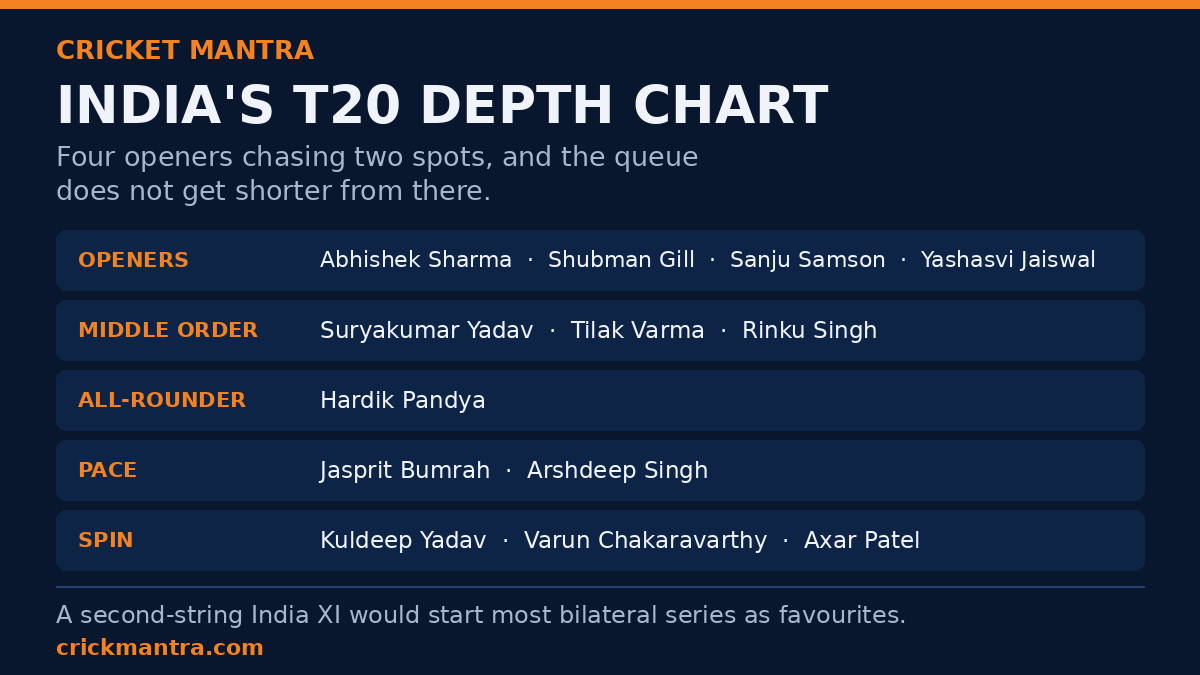
Start at the top of the order. Abhishek Sharma has turned the powerplay into a highlight reel. Shubman Gill plays the same role with a completely different method and a mountain of runs behind him. Sanju Samson has waited years for a consistent run and keeps producing innings that make his exclusion look silly. Yashasvi Jaiswal, who would walk into almost any other T20 side on the planet, is somehow part of this conversation as a backup option. That is four openers for two spots, and we have not even reached the middle order yet.
It does not thin out from there. Suryakumar Yadav remains the most inventive T20 batter in the world on his day. Tilak Varma has shown he can both rebuild an innings and accelerate it. Rinku Singh built a reputation as a finisher out of almost nothing. Hardik Pandya is still the balance point of the whole side when fit, because a genuine seam bowling all-rounder changes what everyone else is allowed to do. Behind them sits a line of IPL performers who have already shown they can handle the biggest stages club cricket offers.
The bowling tells the same story. Jasprit Bumrah picks himself. Arshdeep Singh has become a powerplay and death overs specialist. India can choose between wrist spin, finger spin and mystery spin depending on conditions, and every IPL season produces domestic bowlers taking big wickets who still cannot get near the squad. A second string India side, picked entirely from players left out of the first choice XI, would start most bilateral series as favorites against full strength opposition. That is not hype. It is a fair reading of the depth chart.
So why call it a problem? Because depth only helps if the selection process stays clear headed, and India's has not always managed that. The risk is not a lack of talent. The risk is churn. When three players compete for one role, every failure feels like a verdict. A young batter who knows one quiet series could cost him his place for a year does not play with freedom. He plays to survive, and T20 cricket punishes survival mode faster than any format ever invented.
There is also the temptation to pick on reputation and ceiling rather than fit. A squad is not a collection of the eleven best individuals. It is a set of roles. The finisher who faces twelve balls a match needs a different skill set from the anchor who bats through an innings, and the IPL, for all its data, sometimes blurs that line because franchise roles do not map neatly onto international ones. Picking a player for the wrong slot and then dropping him for failing at it is the one unforced error this much depth should never produce.
My view is simple. Bilateral series are exactly where rotation belongs, and India should keep using them to test combinations and keep the wider pool match ready. But a settled core has to be locked in well before a global tournament, not during it. The players in that core need to know their roles, their likely batting positions and the length of the rope they will get. Certainty is a performance enhancer. The teams that win World Cups are rarely the ones still experimenting in the final month.
The counterargument deserves a fair hearing. Competition is healthy. Nobody in this squad can coast, because there is always someone younger scoring runs or taking wickets and demanding a look. Standards stay high precisely because places are fragile. All of that is true, and it is a big reason the talent keeps coming. The IPL deserves credit here too. It gives selectors a huge sample of high pressure cricket to judge from, instead of guesswork based on a handful of domestic matches.
But there is a line between healthy competition and a permanent audition, and India have crossed it before, most painfully in the long and messy search for a settled number four in one day cricket before the 2019 World Cup. That episode should stay pinned to the wall of every selection meeting. A problem of plenty is still a problem if it leads to indecision at the moment it matters most.
India will probably keep winning most of the T20 cricket they play, because talent this deep papers over a lot of cracks. The question is whether the selectors treat the depth as a luxury to enjoy or as a decision to make early and stand behind. The bench is not the headache. Indecision is.
Hero photo: Wankhede Stadium during the 2011 World Cup final, by G patkar, via Wikimedia Commons, licensed under CC BY-SA 3.0. Depth chart graphic: Cricket Mantra.
Tags:
Cricket Mantra
Cricket Mantra contributor covering the latest cricket news, match analysis and updates from around the world.